
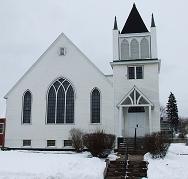
Brunswick Street United Church Presents
Beans and Brownbread
How to raise $3,000 in 6 weeks.
- Offer 1 litre of home-baked beans and a loaf of freshly baked brown-bread (makes about 4 servings) to the general public on a take-out basis for a price of $7.00.
- Prepare and sell 105 meals per week for 6 weeks - 630 meals in all.
- The net profit should be about $5.00 per order - if not, adjust the selling price accordingly. 630 meals @ $ 5.00 = $3,150.
A volunteer Project Coordinator will be required to manage this project and insure its success.
HOW CHURCHS CAN USE BAKED BEANS AND BROWN-BREAD AS A FUND RAISER
- Decide on the length of the fund raising effort - we find 6 weeks is about right.
- You will need the support of the pastor and the congregation to be successful.
- You will need a dedicated committee of at least three persons to be successful.
- There are 3 CRITICAL SUCCESS FACTORS that must be
covered:
- Promotion coordinator - use radio, church bulletin, public bulleting boards, the press and fliers to publicize the event, prior to and during the campaign. Arrange desiign and production of flyers. Arrange for advertising signage to be placed around the delivery site on delivery day.
- Production Coordinator - recruits the cooking volunteers, arranges distribution of the ingredients to the cookers, makes sure everyone is using the same recipe and maintains enthusiastic morale among the cookers.
- Logistics Coordinator - recruits and negotiates with suppliers for needed supplies, makes sure needed supplies are ordered and delivered where needed on time, makes sure the goods are packaged and ready for delivery at the appointed time and makes sure that payments are collected and accounted for properly.
- Just DO IT!
Bean supper production:
- The production coordinator will recruit volunteers who will agree to bake a crock of beans one or more weeks during the 6 week project.
- Cookers must all use ONE and the same recipe.
- Supplies (a copy of the recipe, 1 KG of dry beans, molasses, bacon and containers) will be picked up Tuesday at 1 PM the first week. Cookers are expected to contribute onions, ketchup and dry mustard as needed.
- Beans in containers will be delivered to the beanery on Fridays at 1 PM by the volunteers who prepared them
- The logistics coordinator will pick up loaves of freshly baked brown-bread from the supplier at 12 noon on Friday and deliver to the beanery.
- Packers will place a loaf of bread and a container of beans in plastic bags. One bag makes up an order.
- Meals will be available for pick-up by the public on a first come, first served basis at the advertised beanery location starting at 3 PM until 6 PM Fridays. Patrons will pay the cashier and pick up their order.
Marketing and Promotion
This will be coordinated by the project coordinator.
At the launch of the project, publicity must be sought through the local radio stations and the cable-TV station and daily news papers. Public bulletin boards in grocery and drug stores should have posters as well.
Initially, flyers will be distributed in the mail boxes of all households in the service area by volunteers, which can include the Sunday-school classes. Some congregation members may wish to post the flyers on bulletin boards at work. This will be done starting the first week before the first delivery. A second distribution should be considered at week 3 in the project, if needed.
Cashier
The cashier will be supplied by the Committee of Stewards. Assistants will be supplied as necessary. Full accounting of all expenditures on supplies and receipt of payments and donations is required. Security of the cash during the delivery process and banking the cash afterward are issues to be addressed during the planning stage.
Expediting
The logistics coordinator will arrange for purchasing and delivering supplies of bread, beans, molasses and bacon to the delivery location, obtaining donations whenever possible.
You may wish to consider reservations, If so, the first week, there will be no reservations at all. After the first week, current week customers would be able to reserve their order(s) for the next week.
You may wish to consider offering a call ahead number to call Friday afternoons. Say a customer wants to buy the beans but can't pick them up until 5:30 � anytime after 3:00 PM, she would be able to call ahead and ask the team to save an order until she can get there. If you offer this, it should be displayed on your flyers
A walk-through from the point-of-view of:
The Customer:
- Potential customer receives flyer in mail box or hears about the supper from a friend, or on the radio, TV or in the paper.
- Recipient decides to place order and puts a reminder on the fridge.
- Friday afternoon, customer arrives at beanery to pick up the order.
- Customer pays the cashier, takes order and leaves.
The Bean baker:
- Volunteer picks up bean supply, containers, spices, etc. at the beanery on Tuesday, 1 PM.
- On Wednesday afternoon beans are placed in soak overnight.
- On Thursday morning the beans are cooked per recipe. When cooled, beans are spooned into the 1 litre containers.
- On Friday at 1 PM beans are delivered to the beanery.
The Cashier:
- Starting at 3 PM, until 6 PM, money is received as orders picked up by customers.
- At 6 PM or shortly thereafter, all orders should have been picked up.
- The cashier will tabulate the results and prepare a bank deposit, which will be placed in the night depositary at the bank (or follow such other procedure as has been decided).
The Order fulfillment team:
- Starting at 1 PM on Friday, bean containers and brown bread loafs will be received from suppliers.
- 1 container of beans and 1 loaf of brown bread will be placed in each plastic bag and tied.
- The bags will be conveniently arranged so that they can be given to customers by the helpers.
- Signage advertising the bean suppers will be placed outside the beanery.
- At 3 PM customers will begin arriving.
- At 6 PM or shortly thereafter, all orders should have been picked up. Any left over orders will be frozen and made available next week.
- All signage surrounding the beanery will be removed and stored inside for next week.
The Promotional team:
- Your target market is the general public in the area surrounding the beanery.
- Part of your target market is people driving home from work.
- Notify radio stations and news papers of your event a week or two prior, according to their rules. This may have to be repeated each week of the project, depending on the station or paper. Plan the placement of posters at specific high-traffic areas within your target market area.
- The plan is to distribute flyers at the start-up of the project and again when/if necessary.
- The area surrounding the beanery should be divided into areas that can be conveniently serviced by one person. The number of households within the area will determine how many flyers in total to produce.
- Flyers will be distributed throughout each targeted area by assigned volunteers. This prevents households receiving multiple copies of the flyer.
- Volunteers will pickup a supply of flyers and distribute them on Monday morning of the start-up week.
- A Flyer will be placed in each mailbox within the volunteers territory.
- Members of the congregation may wish to distribute flyers to local stores or places of employment. These would be in addition to the area coverage discussed above.
THE END
Written by:
James Shand
Brunswick St. United Church
Truro, Nova Scotia
January, 2007